

IMMEDIATE RELEASE: Major Milestone Achieved
Contact: Sharon J. Hill Phone: 678.900.2405 Email: crmmedia@creatorsrightsmovement.com
CRM ENDS 2025 WITH RECORD MOMENTUM: COPYRIGHT PETITION SURPASSES 1,000 SIGNATURES
ATLANTA, GA — December 15, 2025 — The Creators’ Rights Movement (CRM) announces a powerful conclusion to the fourth quarter of 2025, marked by critical milestones signaling public urgency for legislative reform.
The global petition demanding Perpetual Copyright Law Reform surpassed 1,000 signatures on November 13th, affirming the widespread demand for economic justice for creators in the age of unchecked AI exploitation.
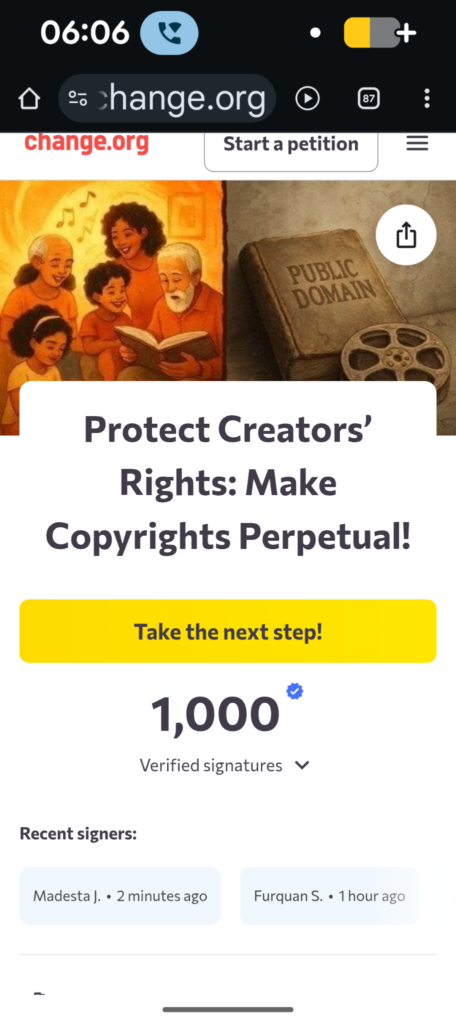
A Quarter of Unprecedented Advocacy
The petition’s success comes on the heels of a sustained advocacy campaign that kicked off post-Labor Day, including national broadcast and social media interviews, key creative support, and significant industry visibility.
CRM’s momentum was further solidified by:
- Entertainment Leadership: The onboarding of the esteemed “Singer’s Producer,” Charles Wallert, as the National Entertainment Industry Liaison. Mr. Wallert, a Lifetime Grammy Voting Member with a distinguished history with artists like George Benson and Dionne Warwick, now brings his vision of economic justice to the movement.
- Industry Recognition: The CRM Panel featured during the Writing Sessions of America (WSA) Virtual Indie-preneur Conference, which included a celebrated Melba Moore tribute presentation to Jonetta Patton, underscoring the vital legacy of creative stewardship.
CRM Founder Mark G. Goldstein addressed the movement’s success, detailing the mandate for policy change:
MARK G. GOLDSTEIN, Founder and Convenor of the Creators’ Rights Movement:
“Exceeding 1,000 signatures is not just a milestone; it is a mandate from the public that copyrights have real monetary value and should not be allowed to expire. We are building a platform for history: it is time to modernize existing laws by creating perpetual copyright protection for all creators.”
The Universal Call for Ownership: From Blues to Beach Music
The urgency for Perpetual Copyright Reform transcends genre, age, and medium, uniting every creator under the banner of economic justice. The petition, featured across platforms from The Blues to various cultural industries, stands as a unified call for all—from youth to seasoned creatives, from poetry, motivational quotes, and sermons, to filmmaking, authors, and athletes, visual artists, crafts, and artisans, alike. It is a demand for generational ownership protection.
This fight is fueled by the painful lessons of history and contemporary struggle:
- The Cost of Lost Ownership: The recent Rock and Roll Hall of Fame Award acceptance speech by Artists Salt-N-Pepa resonated globally, citing the devastating impact of still not owning their music—a loss of legacy and labor.
- The Defense of Legacy: The legendary Dolly Parton provided a stark example of defending generational wealth, citing on the Drew Barrymore Show why Elvis Presley did not record “I Will Always Love You.” Parton famously stood firm and refused to give up her publishing rights, stating, “I said no to giving up my publishing rights to keep the money for my family.”
- The Modern Battle: This struggle is immediate, illustrated by the nine years Charles Wallert fought to regain control of his music from unauthorized YouTube and overseas exploitation.
The time is NOW for Copyright Law Reform. CRM Founder Mark G. Goldstein, fueled by the principle and stand the late Congressman Sonny Bono stood for, now stands in his stead, having amassed a coalesced Movement committed to perpetual policy change, once and for all.
In 2026, as FIFA brings the world to the US, CRM forges forward to ensure the same economic impact anticipated by the host cities is achieved for all creators to secure perpetual legacy protection.
“I am honored to announce that the esteemed Charles Wallert is an official representative of the Creators’ Rights Movement,” Goldstein cited. “We thank everyone who has joined the fight, and we urge everyone else: Stand up, be counted, and help us make history.”
About the Creators’ Rights Movement (CRM)
The Creators’ Rights Movement advocates, led by founder Mark G. Goldstein with partners Kimberly Weekes, Director of Advocacy, and Eudon “Bless” Delemar, Development Director, for recognizing creative professionals as part of the broader labor movement. CRM promotes perpetual copyright protection, fair compensation, and legacy preservation for artists, writers, producers, and innovators through education, advocacy, and public engagement.
Visit CRM at creatorsrightsmovement.com
Sign the Copyright Petition Now
#CreatorsRightsMovement
# # #
Watch here for the Backstory: Why Dolly Parton Didn’t Record “I Will Always Love You” with Elvis…Re-aired Friday, November 21st, a week to the day and time of the CRM Panel during the Writing Sessions of America Virtual Conference, November 14th, 10 AM EST.
The Drew Barrymore Show
YouTube·Nov 27, 2023
Description: Why didn’t Dolly Parton record “I Will Always Love You” with Elvis?
In this video
Dolly Parton didn’t record “I Will Always Love You” with Elvis Presley because Colonel Tom Parker, Elvis’s manager, demanded half of the publishing rights to the song, which Parton refused. Parton had already had a number one hit with the song and wanted to retain ownership of her biggest copyright.
Parton explained on The Drew Barrymore Show that she had already had a number one hit with “I Will Always Love You” and had started her own publishing company. She considered the song her biggest copyright at the time and wanted to keep the publishing rights for her family. When Colonel Tom Parker contacted her about Elvis recording the song, he insisted on having at least half of the publishing rights. Parton refused, stating that he couldn’t have any of the publishing rights. As a result, Elvis never recorded the song. Parton later expressed that she was heartbroken, but ultimately glad she kept the publishing rights, especially after Whitney Houston’s version became a worldwide hit. Parton emphasized that she made the decision as a businesswoman, exercising the business side of the music industry.